How to Choose the Right POD Platform: 5 Questions Only You Can Answer
Choosing a POD platform is less about features and more about fit. Answer these five honest questions before you touch Printify, Printful or Gelato.
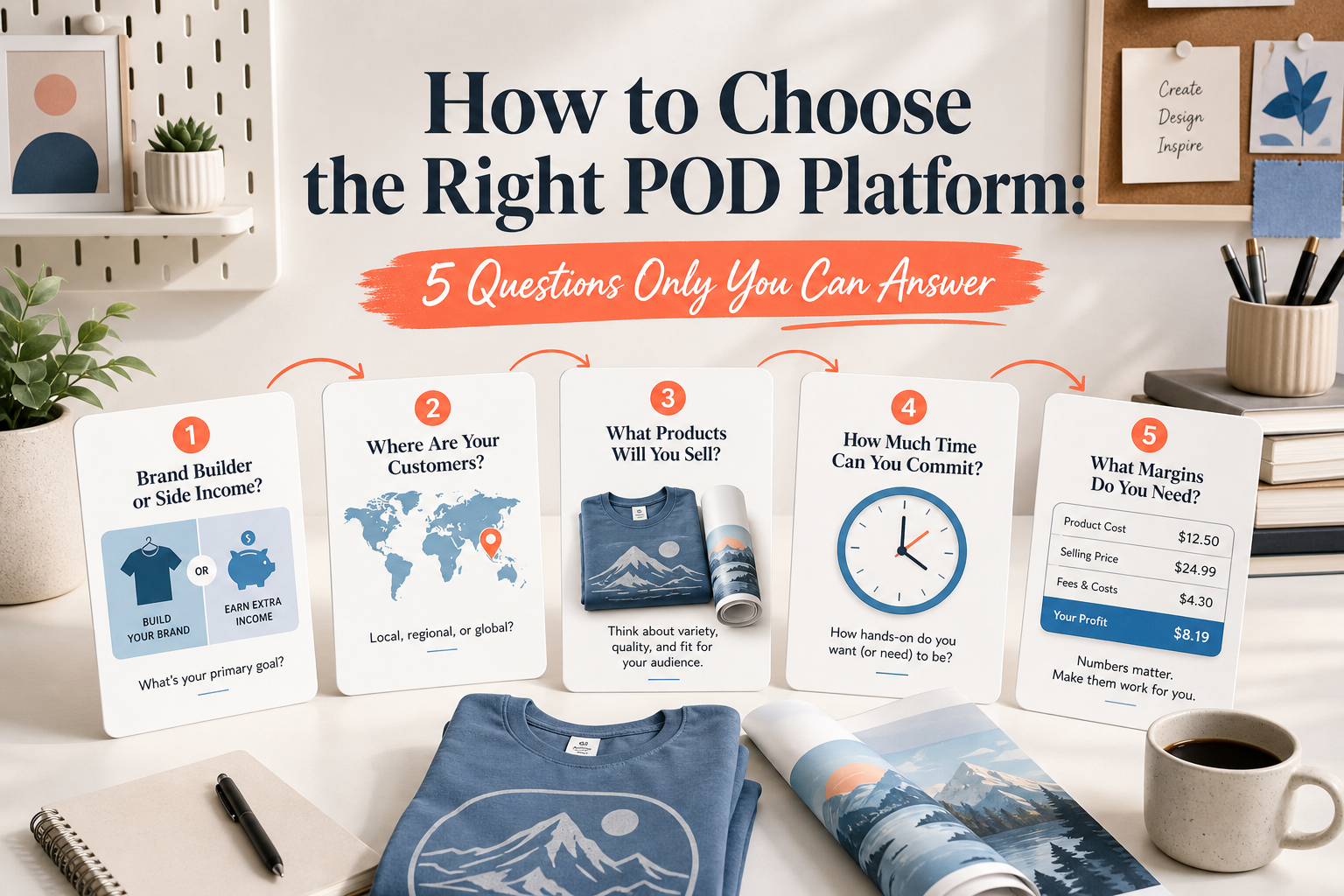
There are now well over a hundred credible print-on-demand platforms, and every one of them claims to be the best choice for creators. Spec sheets and side-by-side tables can only take you so far — two sellers with identical product ideas will often pick different POD partners and both be right.
That is because the hardest part of choosing the right POD platform is not comparing features. It is being honest about how you want to run your business. The global POD market is on track to grow past $37 billion by 2030 at roughly a 25% CAGR, so the tooling keeps getting better. Your job is to match it to your plan.
Before you open another comparison video, sit with these five questions. They are the ones no reviewer can answer for you.
1. Am I building a brand, or buying myself a side income? #
This is the question that quietly decides everything else.
If you want a brand, you need a storefront you control — typically Shopify, WooCommerce, Squarespace or an Etsy shop — connected to a fulfilment partner such as Printful, Printify or Gelato. You own the customer data, the email list, the packaging, the returns experience. Margins are better, but every sale starts with you bringing traffic.
If you want passive exposure, a marketplace such as Redbubble or Society6 does the discovery for you. Royalties are smaller, you cannot email your buyers, and the marketplace sets the product range. In return you get built-in search traffic and zero store admin.
Plenty of creators run both — a marketplace shop for scattered SKUs and an owned store for hero designs. That is fine, but decide which channel is your flagship before you pick tooling, because a branding-led store demands different things from a supplier than a passive marketplace listing.
2. Where do my customers actually live? #
Fulfilment geography is boring until the first international customer pays more for shipping than for the product itself.
Ask yourself where your audience sits today (Google Analytics, Instagram Insights or Etsy Stats will tell you in five minutes) and where it is realistically going. Then match that to a production model:
- US-centric audience — almost any major platform works. Printful and Printify both have strong US production; CustomCat, InterestPrint, Tapstitch and PopCustoms print domestically as well.
- UK or EU-centric audience — local production matters more than brand prestige. Inkthreadable, Teemill, TPOP and Podbase fulfil inside Europe, which matters even more after the EU’s 2026 low-value consignment reforms remove the €150 duty-free threshold.
- Global audience — network models win. Gelato routes to 140+ partners in 30+ countries and Peecho does the same for books and wall art. Printify’s open network covers similar ground with more manual management.
Cheaper shipping labels rarely move the needle. Fewer shipping labels, because production is already local, moves everything.
3. What products am I actually willing to stake a brand on? #
Most POD suppliers will quote a catalogue of hundreds or even thousands of products. You only need one or two to make a living. The question is which specific items feel consistent with your brand, and which supplier prints those items the best.
Narrow your shortlist to the product types that matter, then match to the specialists:
| If your core product is… | Strong specialist options | Why |
|---|---|---|
| Premium apparel (brand-led) | Printful, Tapstitch, Teemill | In-house production, heavier fabrics (250–400 gsm), white-label branding |
| Budget apparel (margin-led) | Printify, CustomCat, Merchize | Multiple print partners, aggressive base costs, fast fulfilment options |
| Wall art and posters | Gelato, Peecho, Society6 | Paper variety, local printing, colour-accurate giclée workflows |
| Photo books and magazines | Peecho | Layflat bindings, global print network, Print API |
| Tech accessories | Podbase, PopCustoms | UV printing, phone and laptop cases, 24-hour turnaround |
| Sustainable / organic | Teemill, Inkthreadable, TPOP | Organic cotton, water-based inks, circular and carbon-neutral shipping |
Order samples from your top two candidates before you commit. A stunning mockup on-screen means nothing until you have held the garment, smelled the ink, and felt the packaging. No review will ever be a substitute.
4. How much ongoing work am I prepared to do? #
There is a real trade-off between margin and management, and reviewers gloss over it because it is hard to quantify.
- In-house models (Printful, Podbase, Teemill, Tapstitch) own their factories. Quality is consistent, customer service goes to one team, and you spend less time firefighting. Base costs are higher.
- Network models (Printify, Gelato, Gooten, Peecho) route orders across third-party print partners. You get catalogue breadth, regional production and sharper prices, but you may need to vet partners, re-route when one runs out of stock, and handle variation between facilities.
- Marketplaces (Redbubble, Society6) take almost all operational work off your plate. They also take most of the margin and all of the customer relationship.
Be honest about your bandwidth. If you have a day job and two hours a week for your store, a network model with 30 SKUs is a recipe for quiet resentment. If you enjoy tweaking, you can squeeze real profit out of Printify by choosing partners per product. The right answer is the one that still sounds reasonable on a Tuesday evening when you are tired.
5. What is my margin floor, once everything is counted? #
“POD has no upfront cost” is a half-truth. Before you list a single product, tally the real monthly spend so you know what a sale has to cover.
| Cost bucket | What to include |
|---|---|
| Base product cost | Blank + print fees, per unit |
| Platform subscriptions | Printify Premium ($39/mo), Printful Growth ($24.99/mo), Gelato+ ($23.99/mo) — or stay free with higher unit prices |
| Store fees | Shopify ($29+/mo), Etsy listing and transaction fees, domain, email |
| Shipping | Label cost (often flat per product), customer-facing rate |
| Payment processing | Typically 2.5–3.5% + fixed fee |
| Design and mockup tools | Canva, Placeit, Photoshop subscriptions |
| Sampling budget | Plan for 3–10 samples per new product line |
Then set a minimum retail price that covers all of the above, plus enough margin to fund marketing and your own time. If the number lands uncomfortably close to the blank’s RRP on Amazon, reconsider either the product or the supplier. No volume of sales will save a product that loses money after fees.
A quick sanity check: if your gross margin after base cost and platform fees is below about 30%, you either need a different product, a cheaper supplier (or network partner), or a different pricing strategy. Good brands usually sit at 45–60% on hero SKUs.
Putting the five answers together #
Once you have written down a one-sentence answer to each question, the platform shortlist almost chooses itself:
- Brand + global + apparel + low-ops + healthy margin → Printful as primary, Gelato for EU wall art
- Side income + UK audience + sustainability-led → Teemill or Inkthreadable, with a Shopify or TikTok Shop front
- Marketplace exposure + casual posting → Redbubble and Society6, no subscription, accept the lower margin
- Niche catalogue + aggressive pricing + willing to manage → Printify with hand-picked print partners, plus Podbase for tech accessories
Do not agonise over locking in “the one”. Most sellers end up using two or three POD platforms within a year, and switching is rarely as painful as you fear. The important thing is to start from your own answers, not someone else’s ranking.
Frequently asked questions #
Can I use more than one POD platform at once? #
Yes, and most serious sellers do. A common pattern is a primary in-house partner for apparel (Printful or Teemill), a network partner for catalogue expansion (Printify or Gelato), and a marketplace presence (Redbubble or Society6) for passive discovery. Just keep SKUs separate so inventory and pricing do not drift.
Which POD platform is best for complete beginners? #
For people who have never sold anything online, a marketplace like Redbubble is the gentlest start — no store setup, no monthly fees, no shipping questions. For anyone who wants to build a brand from day one, Printify with Etsy or Printful with Shopify are the two most forgiving combinations. Start with one product, one platform, one channel.
Do I need a paid subscription to make POD work? #
No. Every major platform — Printify, Printful, Gelato, Teemill, TPOP — has a free tier that will let you sell indefinitely. Paid plans unlock lower base costs, extra branding features, or advanced analytics, and they usually pay for themselves once you are selling 30–50 items a month. Below that, stay on the free plan.
How do I evaluate print quality without guessing? #
Order a sample of the exact product, colour and size you plan to list, using your own artwork. Wash it three times on a normal cycle, check for cracking, fading and colour shift, then photograph it next to a mockup to compare tones. If a supplier does not offer samples at a discount, that alone is a warning sign.
Storefront or marketplace — which pays better long term? #
A well-run storefront almost always beats a marketplace on margin per sale, but requires ongoing marketing. A marketplace pays less per sale but keeps paying while you do nothing. If you are aiming at a career business, storefront wins. If you are aiming at a creative side project, marketplace wins on effort-adjusted return.
Next step #
The point of these five questions is to turn a noisy market into a short, honest shortlist. Once you have that, the comparisons become useful again. Ready to compare your shortlist side by side? Browse the full Printsgram print-on-demand directory and filter by region, product type and integration to see who actually fits your plan.